by popadmin | Jul 4, 2021 | CIC Saint Writeups
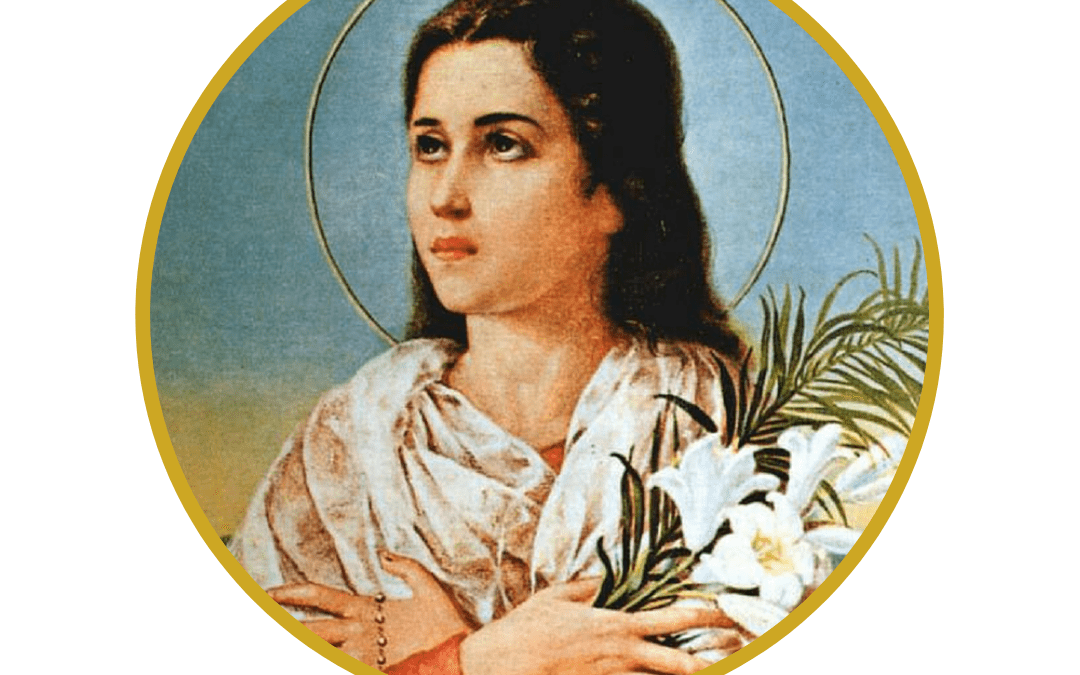
6 July: Feast of Saint Maria Goretti, virgin and martyr. Maria was born in 1890, one of six children from an impoverished farming family in Italy. In exchange for farm work, the Goretti’s lived in the owner’s abandoned factory. They shared it with another poor family, the Serenelli’s (Giovanni and his son, Alessandro). The farmland they worked was swampy, mosquito infested, and difficult to work. Maria’s father contracted malaria and died when she was nine. Maria’s mother, Assunta, had to take her husband’s place in the fields. This left Maria to take her mother’s place. Maria cooked, cleaned, did laundry, and cared for younger siblings. Maria never complained, she was an extremely pious child. In contrast, Alessandro was a rough youth, given to drinking, swearing, and callous behavior. He had impure thoughts toward Maria and would speak to her crudely. Maria, in her great love for God, abhorred his behavior. One day, Alessandro attacked Maria. She resisted his sinful behavior saying, “No! It is a sin! God does not want it!” Alexander stabbed her fourteen times. At the hospital, doctors tried to save Maria’s life. She experienced horrific suffering, undergoing surgery without anesthesia. Halfway through the surgery, the doctor said, “Maria, think of me in Paradise.” Maria looked up and said, “Well, who knows which of us is going to be there first?” She did not realize how terrible her situation was, and the surgeon replied, “You, Maria.” She said, “Then I will think gladly of you.” Despite valiant effort, doctors couldn’t control Maria’s bleeding or infection. After twenty excruciating hours of suffering, Maria died at the age of 11. In her last moments the priest asked Maria to forgive her attacker. Her last words were “I forgive Alessandro Serenelli …and I want him with me in heaven forever.” Alessandro was arrested and sentenced to 30 years in prison. While in prison, Maria appeared to Alessandro and forgave him. That act of mercy filled Alessandro with utter contrition for his crime. From that point on, he lived a life of holiness. After his release, he sought out the forgiveness of Maria’s mother. Assunta told him, “If Maria forgives you, and God forgives you, how can I not also forgive you?” The two went together to Mass and received Holy Communion side by side. Assunta then adopted Alessandro as her own son. He eventually joined the Capuchin Franciscans as a lay brother. On April 27, 1947, Maria was beatified; she was canonized on June 24, 1950 by Pope Pius XII. Alessandro Serenelli was in attendance at that historic ceremony, where the young girl he murdered was declared a saint. Maria’s canonization was also attended by Assunta, the first time in history that a mother was present to witness the canonization of her own child. Also present were Assunta’s four remaining children. The crowd that attended Maria’s canonization, estimated at 500,000, was the largest ever up to that point in the Church’s history. There were so many people that it was held outdoors in St. Peter’s Square, because the massive basilica was too small to hold all the faithful in attendance. St. Maria Goretti is known as the Little Saint of Great Mercy.
“The life of this simple girl—we can see as worthy of heaven…Parents can learn from her story how to raise their God-given children in virtue, courage and holiness; they can learn to train them in the Catholic faith so that, when put to the test, God’s grace will support them and they will come through undefeated, unscathed and untarnished.” – Pope Pius XII at the canonization of St. Maria Goretti
Ideas for celebrating this feast at home:
- Visit MariaGoretti.com or read St. Maria Goretti: In Garments All Red for more on this beautiful saint.
- St. Maria is a virtuous role model and her feast day is a wonderful launching point to teach children about the virtues of purity, modesty and forgiveness.
- Watch this Vatican film about Maria. More are on the FORMED website (adult supervision recommended).
- Feast day meal should be Italian in St. Maria’s honor. Idea: Lasagna with breadsticks and salad. For dessert, bake some “Flames of Forgiveness Cupcakes” (instructions here).
(sources: catholicculture.org; showerofrosesblog.com; catholiccompany.com; mariagoretti.com)
by popadmin | Jul 3, 2021 | Parish Life, Podcasts
by popadmin | Jul 3, 2021 | Parish Life, Podcasts
by popadmin | Jul 3, 2021 | Parish Life, Podcasts

by popadmin | Jul 1, 2021 | Bulletin
Click to read the 4 July 2021 Bulletin
“I set my bow in the cloud, and it shall be a sign of the covenant between me and the earth.” – Genesis 9:13
by popadmin | Jun 22, 2021 | Bulletin
Click to read the 27 June 2021 Bulletin
by popadmin | Jun 15, 2021 | Bulletin
Click to read the 20 June 2021 Bulletin!
by popadmin | Jun 14, 2021 | CIC Saint Writeups
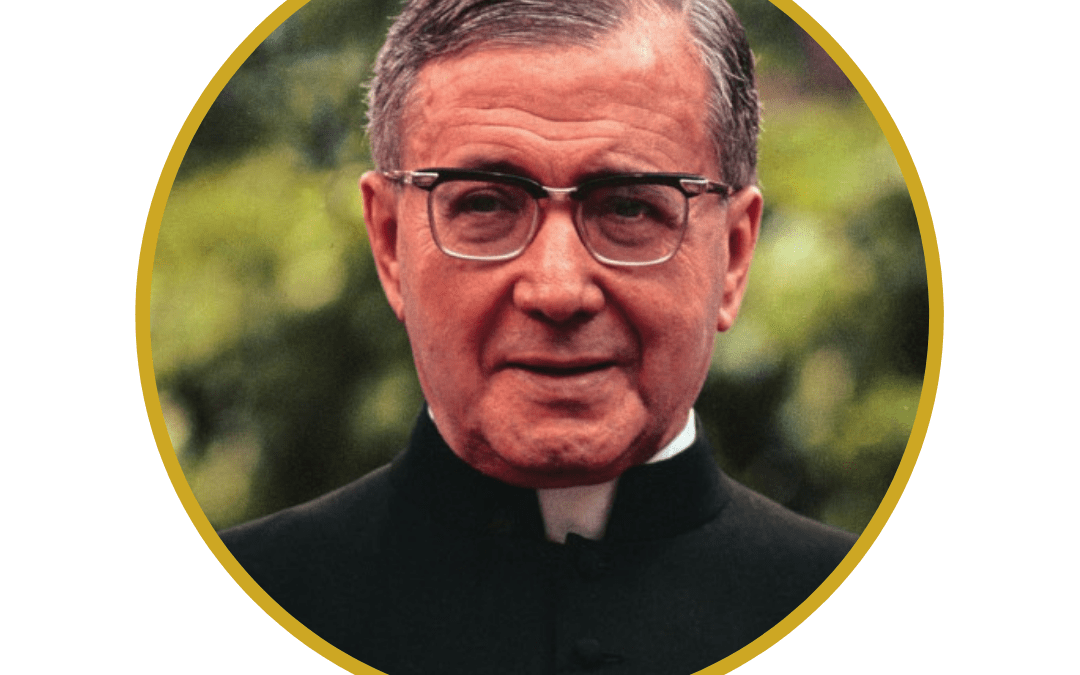
26 June: Feast of Saint Josemaria Escriva de Balaguer. St. Josemaria Escriva was born in Barbastro, Spain, in 1902. Of his five siblings, the three youngest died young. His parents, José and Dolores, raised their children to be devout Catholics. His mother taught Josemaria many prayers he would recite his entire life. In 1915, his father’s business failed and they had to move to find work. The family struggled to get by. It was as a teenager that Josemaria first sensed his vocation. Moved by the sight of footprints left in the snow by a barefoot friar, he felt God was asking something of him. He thought becoming a priest would help him discover this calling from God. He prayed fervently, “Lord, let me see what you want.” Josemaria’s father died in 1924, leaving him as head of the family. He was then ordained in 1925 and began his ministry in a rural parish. In 1927, Fr. Josemaria’s bishop gave him permission to move to Madrid to obtain his doctorate in law. In 1928, during a spiritual retreat, Fr. Josemaria saw what it was that God was asking of him: to found Opus Dei, a way of sanctification in daily work and through a Christian’s ordinary duties. The name “Opus Dei” is Latin for “Work of God”. (Opus Dei’s mission is to spread the Christian message that every person is called to holiness in ordinary life; the idea that every honest work can be sanctified.) From then on, Josemaria worked to spread the ministry of Opus Dei, while also continuing his priestly ministry. He was also studying at the University of Madrid and teaching classes in order to support his family. When war broke out in Madrid, religious persecution forced Fr. Josemaria to exercise his priestly ministry secretly. Eventually, he was able to leave via a harrowing escape across the Pyrenees, and took up residence in Burgos. In 1939, he returned to Madrid and finally obtained his doctorate in law. In the years that followed he gave retreats to laity, priests, and religious, and continued working to develop Opus Dei. In 1946 Fr. Josemaria moved to Rome and obtained a doctorate in Theology from the Lateran University. He was appointed by Pope Pius XII as a consultor to two Vatican Congregations, as an honorary member of the Pontifical Academy of Theology, and as an honorary prelate. He traveled frequently, working to grow Opus Dei. In 1974 and 1975, he traveled through Latin America, speaking to people about their Christian vocation to holiness. Msgr. Escriva died suddenly of a heart attack on June 26, 1975. By the time of his death, Opus Dei was in dozens of countries and had touched countless lives. After his death, thousands of people (including more than a third of the world’s bishops), sent letters to Rome asking the Pope to open his cause of beatification and canonization. Pope St. John Paul II beatified Msgr. Escriva on May 17, 1992, in St. Peter’s Square. The ceremony was attended by 300,000 people. “With supernatural intuition,” said the Pope in his homily, “Blessed Josemaria untiringly preached the universal call to holiness and apostolate.” Ten years later, on October 6, 2002, John Paul II canonized the founder of Opus Dei in St. Peter’s Square before a multitude of people from more than 80 countries, saying, “St. Josemaria was chosen by the Lord to proclaim the universal call to holiness and to indicate that everyday life, its customary activities, are a path towards holiness. It could be said that he was the saint of the ordinary.”
Ideas for celebrating this feast at home:
- Read a longer biography of St. Josemaria here.
- Read Pope St. JP II’s Apostolic Brief on Josemaria Escriva here.
- Visit this site to find St. Josemaria Escriva’s writings.
- See a video about St. Josemaria Escriva here.
- Visit Opus Dei‘s official US website.
- For a feast day meal, make something Spanish. Often involving rice, Spanish dishes are hearty and satisfying, making them ideal for sharing. Invite family or friends over for a Spanish feast in honor of St. Josemaria! Ideas: Spanish rice, paella, gazpacho soup, Arroz con pollo, Spanish flan, sangria.
(sources: catholicculture.org; opusdei.org)
by popadmin | Jun 8, 2021 | Bulletin
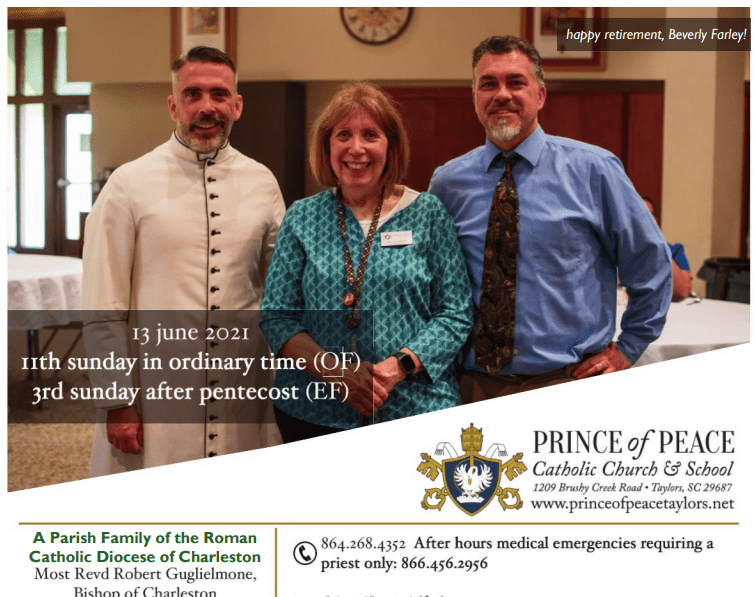
Click to read the 13 June 2021 Bulletin!

by popadmin | Jun 7, 2021 | CIC Saint Writeups
19 June: Feast of Saint Romuald. St. Romuald was born in Ravenna, Italy, to a noble family. No one could have imagined that a descendent of the Dukes of Onesti would have left his stately home for the most absolute austerity, entering history as a great reformer of the Benedictine Order and as Founder of the Congregation of Monk Hermits of Camaldolese, an Order that has given the Church two great Pontiffs, Pius VII and Gregory XVI, as well as a whole array of blesseds and saints. Yet from his youth, Romuald had been attracted to the consecrated life. He sought silence and sacrifice. A turning point in Romuald’s life was when his father killed a relative in a duel at which Romuald was forced to be present. He then fled to the monastery of St. Apollinaris and did penance and fasting for forty days, assuming responsibility for the sins of his father and begging for forgiveness. He prayed and wept almost without ceasing. So was the purity of his heart, and sincerity of repentance, that he was filled with the Holy Spirit, and his faith deepened. He eventually became a monk at the Abby, later becoming Abbot. Romuald went on to found several monasteries throughout Italy, but he longed for an even more austere life than that of the Benedictines. He founded an order of hermits known as the Camaldolese monks (an Italian branch of the Benedictine Order). Romuald’s was one of the strictest orders for men in the West. Members lived isolated in small huts, observing strict silence and perpetual fasting, constantly praying or doing manual labor. The Life of St Romuald notes that the saint was totally enraptured by silence and solitude with God: “Contemplation of God enraptured him so forcefully that, almost blinded by tears and burning with an indescribable fire of love for God, he would cry out, `Dear Jesus, peace of my heart, ineffable desire, sweetness and gentleness of the angels and saints…’” St. Romuald brought many sinners, particularly those of rank and power, back to God. He died in 1027, having lived a life of prayer and rigorous penance. He had never used a bed and had found countless ways to practice severe penances, such as wearing a shirt of hair and eating only gruel. 15 years later, his pupil, St. Peter Damian, wrote in his biography: “His greatness lies in the rigorous and austere character of his interpretation of monastic life-an approach that was quite singular and unique. In the deepest recesses of his being, Romuald was an ascetic, a monk …He reminds us of the stolid figures inhabiting the Eastern deserts, men who by most rigorous mortification and severest self-inflicted penances gave a wanton world a living example of recollection and contemplation. Their very lives constituted the most powerful sermon.” Saint Romuald’s body was buried at the monastery in Paranzo. Three decades later, his incorrupt body was transferred to Fabriano in 1481. Many miracles have been reported at his tomb in the Cathedral of Fabriano. The Order he founded continues to operate today, with five congregations. The most austere of those, the hermits, continue to live like St. Romuald—strict adherence to silence and prayer for the reparation of the sins of mankind.
“Destroy yourself and live only in God.” – Saint Romuald
Ideas for celebrating this feast at home:
- In honor of the place (Tuscany) where St. Romuald founded an order of hermits, make a Tuscan White Bean & Garlic Soup for dinner tonight (recipe here). Perhaps give up dessert as a small penance, in honor of this saint who is known for living a life full of penance.
- Read more about St. Romuald here.
- Spend some time reading the Psalms in silence like St. Romuald. When we pray, St. Romuald said that our bodies, hearts, souls, and minds should be focused solely on God: “Better to pray one psalm with devotion and compunction than a hundred with distraction.”
- Write or print out your favorite passage from Psalms. Tape it on your bathroom mirror, in your car, or someplace you’ll see it every day to ponder and meditate upon.
(sources: catholicculture.org; excerpts from The Church’s Year of Grace by Pius Parsch)
Recent Comments