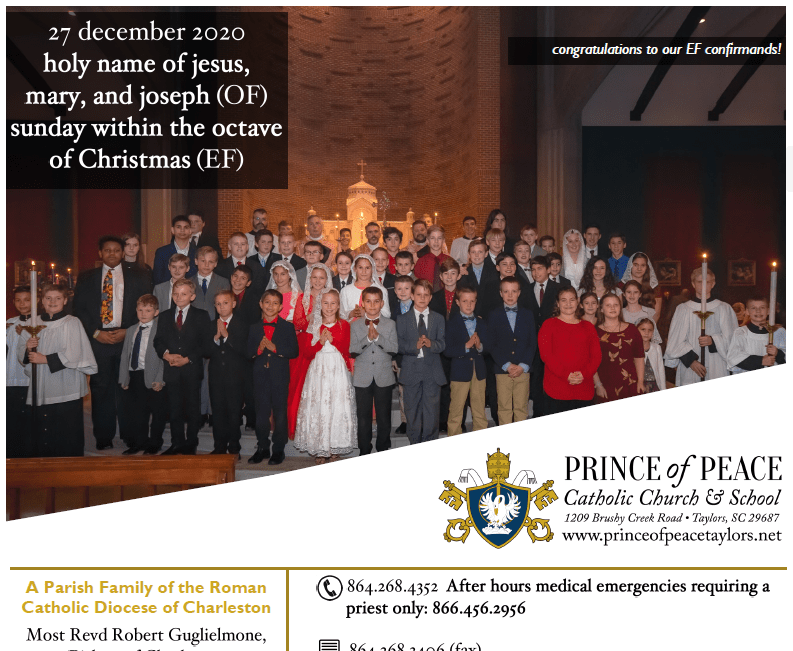
27 December 2020 Bulletin
Click to read this weekend’s bulletin: 27 December 2020
Click to read this weekend’s bulletin: 27 December 2020

27 December: Feast of the Holy Family. Little is known about the life of Jesus’s earthly family. The gospels tell of the early years, including the birth of Jesus in Bethlehem, the flight into Egypt, and the finding of Jesus in the temple. Pope Leo XIII promoted this feast day as a way to counter the breakdown of the family unit. The purpose was to present the Holy Family as the model for all Christian families, and for domestic life in general. Family life becomes sanctified when we live the life of the Church within our homes. This is called the “domestic church” or the “church in miniature.” St. John Chrysostom urged Christians to make each home a “family church,” thus sanctifying the family unit. A good way to do this is by making Christ the center of family and individual life. For example: read scripture regularly, pray together as a family, attend Mass, go to confession, teach children about virtues, learn about and imitate the lives of the saints, live liturgically (follow the church calendar at home), and so forth. It is important to note that we don’t become holy despite the busyness of family life, but in and through it. On this feast, may the virtuous example of the Holy Family of Nazareth inspire us to develop homes full of prayer, love, and holiness.
28 December: Feast of the Holy Innocents (‘Childermas’). On the fourth day in the octave of Christmas, the Church remembers the massacre of innocent children in Bethlehem as told in Matthew 2:16-18. King Herod had ordered the death of all male children aged two and under, in his attempt to kill the infant Jesus. “A voice is heard in Ramah, weeping and great mourning, Rachel weeping for her children and refusing to be comforted, because they are no more.” These children are considered martyrs, Saints of God, by the Church. This feast day is often seen as a day of merrymaking for children. It is custom to give the youngest child in the household the power to rule the day. From what to eat, where to go and what to do, the youngest is in charge. In Mexico, it is a day for children to play practical jokes and pranks on their elders. The Holy Innocents are special patrons of babies and small children, who can please the Christ Child by being obedient and helpful to parents, by sharing toys and loving siblings. This feast is an excellent time for parents to inaugurate the custom of blessing children. Sign a cross on your child’s forehead with the right thumb and say: “May God bless you, and may He be the Guardian of your heart and mind, in the name of the Father, and of the Son, and of the Holy Spirit. Amen.”
Ideas for celebrating at home:
“The first witnesses of Christ’s birth, the shepherds, found themselves not only before the Infant Jesus but also a small family: mother, father and newborn son. God had chosen to reveal himself by being born into a human family and the human family thus became an icon of God! …Indeed, the family is the best school at which to learn to live out those values which give dignity to the person and greatness to peoples. …The Holy Family of Nazareth is truly the “prototype” of every Christian family which, united in the Sacrament of Marriage and nourished by the Word and the Eucharist, is called to carry out the wonderful vocation and mission of being the living cell not only of society but also of the Church, a sign and instrument of unity for the entire human race. …May [the holy family] help Christian families to be, in every part of the world, living images of God’s love.” – Pope Benedict XVI

26 December: Feast of Saint Stephen. On the second day in the octave of Christmas, we celebrate the Feast of St. Stephen, an early Church deacon and the first Christian martyr. The Book of Acts 6-7 tells us about Stephen. He came from a family of Hellenists, Jews who had emigrated from Palestine to the Greek-speaking provinces of the Roman Empire. Tension arose between the Greek Jewish converts to Christianity and the Palestinian Jewish converts. The Greeks thought their needy were being neglected in favor of the Hebrew’s poor. To resolve the problem, the apostles ordained seven men as deacons to serve the poor and preach the Faith. The first name on this list of seven is Stephen. Stephen was renowned for his care of the poor and was held in high esteem by the Apostles. In his zeal for the Faith, he also debated with members of four Greek synagogues. When Stephen’s eloquent speeches got the better of the Hellenist Jews, angry opponents dragged him to the Sanhedrin. False witnesses charged him with blasphemy and reviling the Law of Moses. In answer, Stephen gave a lengthy speech that traced the sacred history of the Jews and concluded with a denunciation of his accusers. Then, suddenly filled with the Holy Spirit, he looked up to heaven and cried, “Behold, I see the heavens opened, and the Son of Man standing at the right hand of God.” This was too much blasphemy for the angry mob of Jews. (The man later to become St. Paul was part of the mob.) They rushed upon Stephen, dragged him outside the city walls and stoned him to death. As the stones struck, he prayed, “Lord Jesus, receive my spirit.” Then, when down on his knees and near death, Stephen prayed again, “Lord, lay not this sin to their charge.” After the mob had dispersed, Christians took his body away for burial.
The Church draws a comparison between St. Stephen and Christ: Stephen’s arrest and trial with false accusations parallels our Savior’s trial; he was stoned outside the city wall; he died echoing the words of Jesus on the cross (praying for his executioners). Saint Stephen is the patron of deacons, altar servers, bricklayers, stonemasons and horses.
Ideas for celebrating this feast day at home:
“If you know what witness means, you understand why God brings St. Stephen, St. John, and the Holy Innocents to the crib in the cave as soon as Christ is born liturgically. To be a witness is to be a martyr. Holy Mother Church wishes us to realize that we were born in baptism to become Christ — He who was the world’s outstanding Martyr.” — Love Does Such Things, by Rev. M. Raymond, O.C.S.O.
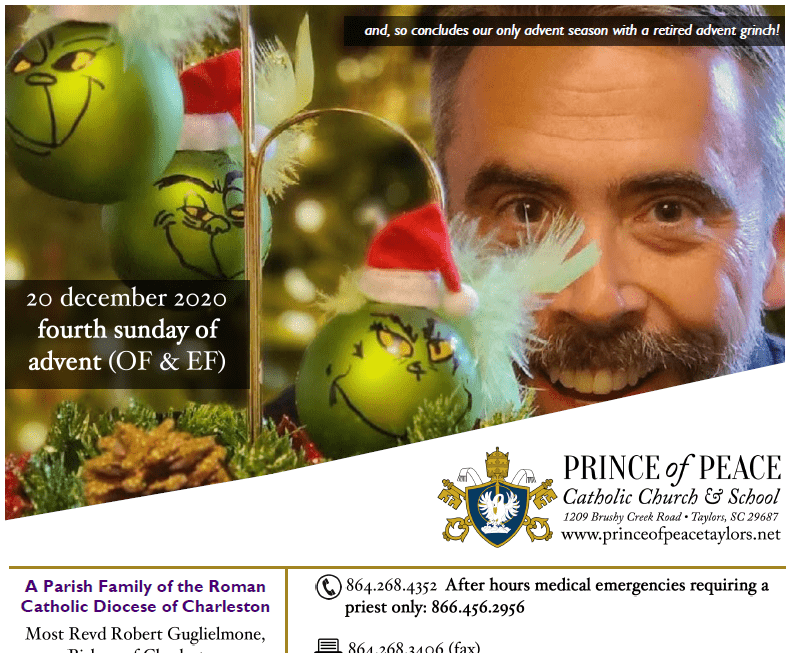
Click to read this week’s bulletin: 20 December 2020
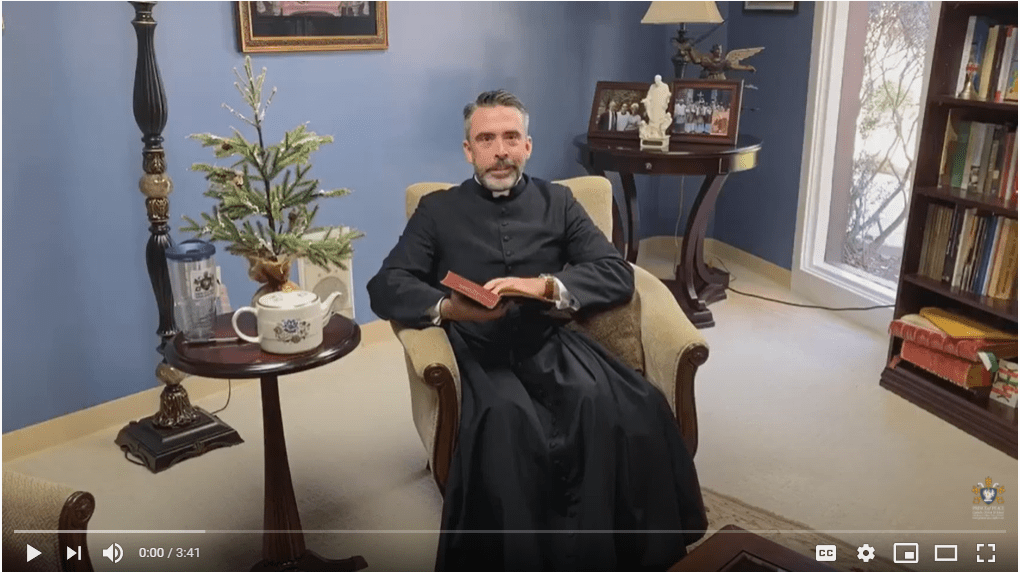
Fr Smith has an important video message announcing a new initiative at Prince of Peace. We have a number of parishioners who would love to come back to Mass and Holy Communion, but they or their families have very specific health needs.
Beginning the first Sunday of January, there will be a Low Mass in English in the PAC with no music or homily at 9.15a. This is an experiment meant to accommodate more of God’s children whose needs are not bring met by current practices in our parish. This Mass will be mask only. Depending on the numbers at that Mass and how that affects numbers at other Masses, it will continue or cease.
This will create an opportunity for a worship environment which more closely meets the specific health needs of a certain group of our parishioners during the pandemic.

[pdf-embedder url=”https://www.princeofpeacetaylors.org/wp-content/uploads/2020/12/Basketball-Protocol.pdf” title=”Basketball Protocol”]
Recent Comments