by popadmin | Jan 9, 2022 | CIC Saint Writeups
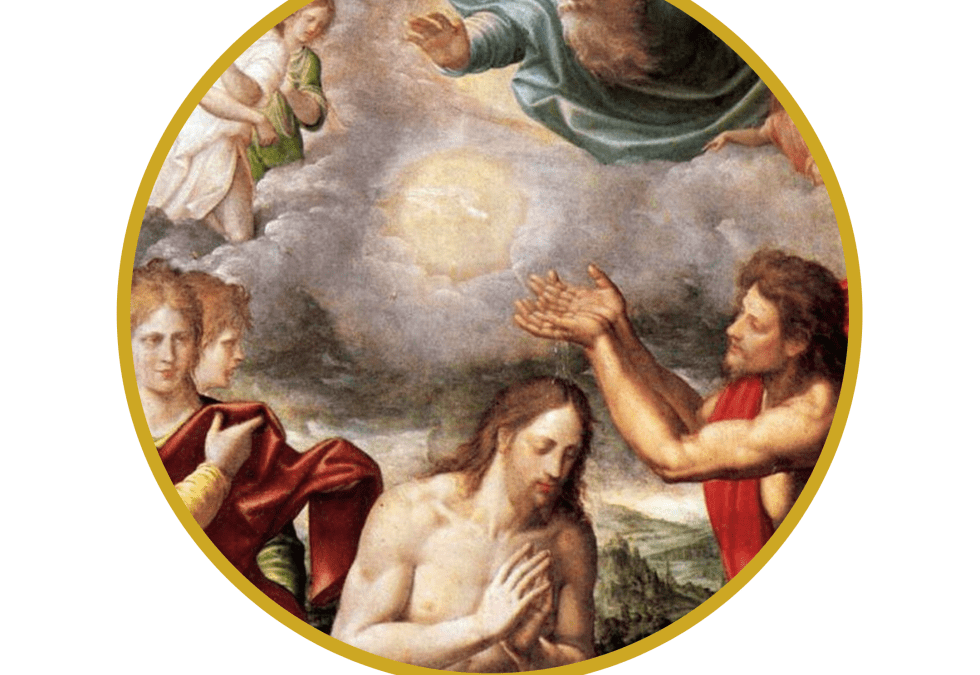
8 January: Feast of the Baptism of the Lord. Today, we celebrate the baptism of Christ in the Jordan by John the Baptist: a milestone event in the life of Jesus and in Christianity. This feast day is usually celebrated on the Sunday after the Feast of the Epiphany. It brings to an end the liturgical season of Christmas. {Christmas is the feast of God’s self-revelation to the Jews, and Epiphany celebrates God’s self-revelation to the Gentiles.} At his Baptism, Christ reveals himself again, this time to repentant sinners. The Baptism of Jesus also marks the first public revelation of all Three Persons in the Holy Trinity, and the official revelation of Jesus as the Son of God to the world by God the Father. Jesus’s baptism is described in all four Gospels and it marks the beginning of his public ministry. “After Jesus was baptized, he came from the water and behold, the heavens were opened [for him], and he saw the Spirit of God descending like a dove [and] coming upon him. And a voice came from the heavens, saying, ‘This is my beloved son, with whom I am well pleased’ ” (Mt 3:16-17). We know that Jesus, holy and sinless, did not need to be baptized. Yet he humbled himself and submitted to his Father’s will. Jesus’s baptism sanctified the waters and instituted the Sacrament of Baptism. The Catechism of the Catholic Church states: Our Lord voluntarily submitted himself to the baptism of St. John, intended for sinners, in order to “fulfill all righteousness.” Jesus’ gesture is a manifestation of his self-emptying. The Spirit who had hovered over the waters of the first creation descended then on the Christ as a prelude of the new creation, and the Father revealed Jesus as his “beloved Son.” (CCC 1224) Fr. Antony Kadavil explains this further: “Neither John nor Jesus invented baptism. It had been practiced for centuries among the Jews as a ritual equivalent to our Confession. Until the fall of the Temple in 70 A.D., it was common for Jewish people to use a special pool called a Mikveh – literally a “collection of water” – as a means of spiritual cleansing. Men took this bath weekly on the eve of the Sabbath; women, monthly. Converts were also expected to take this bath before entering Judaism. The Orthodox Jews still retain the rite. John preached that such a bath was a necessary preparation for the cataclysm that would be wrought by the coming Messiah. Jesus transformed this continuing ritual into the one single, definitive act by which we begin our life of Faith. In effect, He fused His Divine Essence with the water and the ceremony. In this humble submission, we see a foreshadowing of the “baptism” of his bloody death upon the cross. Jesus’ baptism by John was the acceptance and the beginning of his mission as God’s suffering Servant. He allowed himself to be numbered among sinners. Jesus submitted himself entirely to his Father’s will. Out of love, He consented to His baptism of death for the remission of our sins.” On this glorious feast day, we also celebrate our own baptisms, which freed us from sin and made us sons and daughters of God. Through baptism, God has opened the doors to Heaven. Deo gratias!
Ideas for celebrating in your home:
- The Christian symbol for Baptism is the shell, which you can easily turn into a dinner theme. Make pasta shells, Nacho Stuffed Shells, or Italian stuffed shells. Decorate the table with sea shells (children can color or craft some if you don’t have any real ones).
- Pull out your family’s Baptismal candles and light them at dinner. Tell children about the Baptism of Our Lord and their own special Baptismal days! (Share stories from family baptisms around the dinner table: Talk about who was there, how godparents were chosen, celebration afterwards, etc.)
- This is a wonderful day to renew our baptismal vows: click here for instructions.
- Start a family tradition of celebrating baptism anniversaries: Here are ideas!
- Finally, if you have access to a pool, pond, river or stream: we dare you to take a winter plunge in celebration of Jesus’s baptism in the Jordan!
by popadmin | Jan 5, 2022 | Bulletin
Click to read this week’s bulletin: 9 January 2022
by popadmin | Dec 29, 2021 | Liturgy
The Solemnity of Mary, Mother of God is a holy day of obligation. Our Mass schedule is:
- 5p Vigil Mass on Friday, 31 December
- 10a on Saturday, 1 January
- 12n EF (Low Mass of the Circumcision)
*EF = Extraordinary Form
by popadmin | Dec 29, 2021 | Events
Did you know that the Feast of the Epiphany on 6 January, known in the English speaking world as the Twelfth Night of Christmas, is actually far older than Christmas itself, and for centuries was celebrated with eight days, an Octave, of feasting afterwards? The Epiphany comes from a Greek word meaning manifestation and actually commemorates three manifestations of the Divinity of Christ: when the Wise Men give gifts fit for a king and a deity to the Christ Child, when Jesus was baptized by John in the Jordan and the Father from heaven confirms His divine sonship; and the first miracle of Jesus at the Wedding at Cana. There are numerous customs of Catholic culture associated with Epiphany, and this year at Prince of Peace, we are going to celebrate as many as we can both in our parish church and in your domestic church.
2 January – Sunday: the Transferred Solemnity of the Epiphany in the Ordinary Form
8a Low Mass in English
10a The Proclamation of the Movable Feasts of the Year of Our Lord 2022 and Solemn Mass of the Epiphany in English
2 January – Sunday: the Feast of the Holy Name in the Extraordinary Form
12N Low Mass in Latin
5 January – Wednesday: the Vigil of the Epiphany
12N Low Mass EF in Latin
6 January – Thursday: the Traditional Feast of the Epiphany in the Extraordinary Form
6.30p Solemn Blessing of Epiphany Water, Chalk, Gold – Frankincense – Myrrh
7p Solemn High Mass of the Epiphany
8p Royal Procession to the Epiphany Crib and Benediction of the Most Blessed Sacrament
8 January – Saturday
6p Blessing of the Great Nativity and Prosecco Toast for Donors
6p Epiphany Party & Potluck Dinner for Our Parish Family
On the Feast of the Epiphany in the Domestic Church you are invited to do the following:
- Take home blessed chalk which will be available in the narthex from 2-6 January and mark the door of your house with 20 + C + M + B + 22. The year of the Incarnation of Our Lord is accompanied by the initials CMB. In Latin, they stand for two things: Christus mansionem benedicat – May Christ bless this home, as well as the traditional names of the Three Kings, whose relics are in Cologne Cathedral in Germany: Caspar, Melchior and Balthasar.
On the Traditional Feast of the Epiphany, 6 January, we encourage you to come to the evening liturgy and bring with you the following to be blessed by placing them on the table provided in the sanctuary within the Communion rail:
- Containers of water and salt – Chalk – Gold, Frankincense and Myrrh.
- Please mark your names on each item and pick them after the Royal Procession to the Epiphany Crib the same night.
- You can actually buy little coffrets of gold, frankincense and myrrh here.
In Catholic cultures, it was common for the parish priest and the altar servers to go to door in the parish boundaries with blessed Epiphany Water during the Octave of the Epiphany and bless every house in the parish. Because of the size of our territory and the number of parishioners who live outside the territory, that is impossible at Prince of Peace, but you may bring home the water you have blessed at church, mix the salt into it, and sprinkle the inside and outside of your homes and workplaces.
The Eastern Catholic Traditions
To learn more about these amazing Epiphany customs, please read the following:
- To see the actual text of the blessing of Epiphany Water (click here)
- Why Epiphany Water is a powerful sacramental to use against the Evil One (click here)
- The Chalking of the Doors (click here)
- Epiphany Customs (click here)
- Dom Gueranger on the Epiphany (click here)
by popadmin | Dec 29, 2021 | Bulletin
Click to read this week’s bulletin: 2 January 2022
*note the Wednesday Mass is at 8.30a, not 9a
by popadmin | Dec 22, 2021 | CIC Saint Writeups
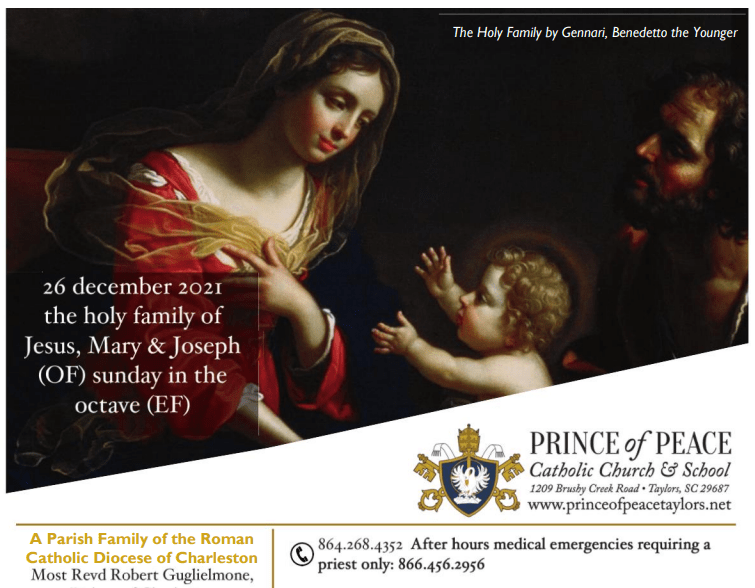
26 December: Feast of the Holy Family. Little is known about the life of Jesus’s earthly family. The gospels tell of the early years: the birth of Jesus in Bethlehem, the flight into Egypt, the finding of Jesus in the temple. Pope Leo XIII promoted this feast day as a way to counter the breakdown of the family unit. The purpose was to present the Holy Family as the model for all Christian families, and for domestic life in general. Family life becomes sanctified when we live the life of the Church within our homes. This is called the “domestic church” or the “church in miniature.” St. John Chrysostom urged Christians to make each home a “family church,” thus sanctifying the family unit. A good way to do this is by making Christ the center of family life: read scripture regularly, pray together as a family, attend Mass, go to confession, teach children about virtues, learn about and imitate the lives of the saints, live liturgically (follow the church calendar at home), and so forth. It is important to note that we don’t become holy despite the busyness of family life, but in and through it. On this feast, may the virtuous example of the Holy Family of Nazareth inspire us to develop homes full of prayer, love, and holiness.
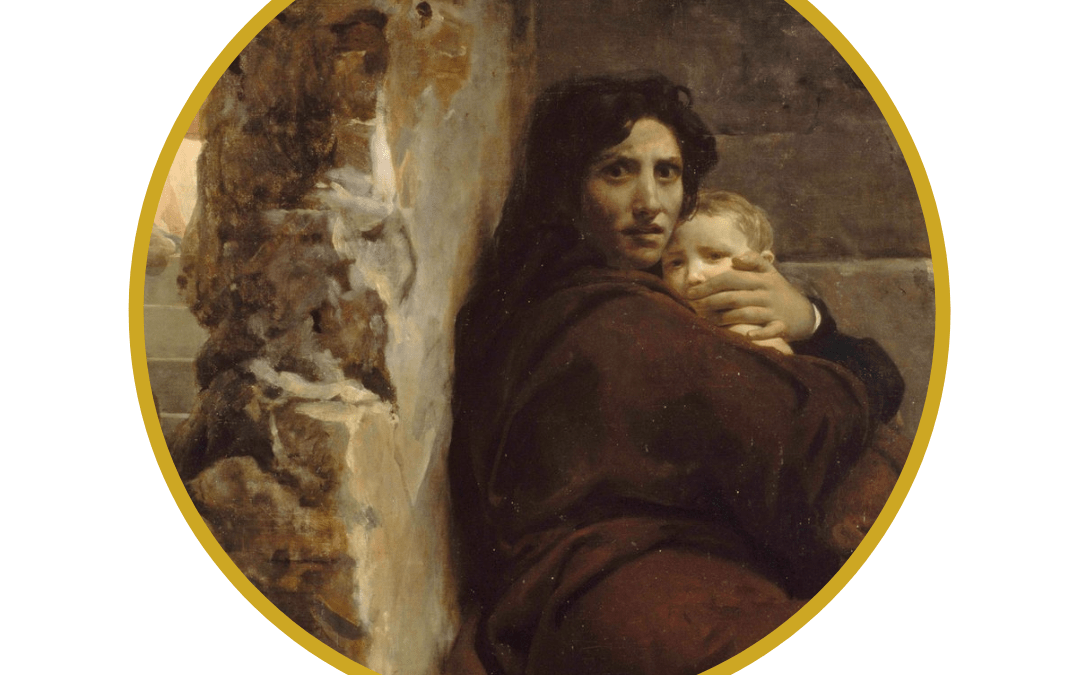
28 December: Feast of the Holy Innocents (‘Childermas’). On the fourth day in the octave of Christmas, the Church remembers the massacre of innocent children in Bethlehem as told in Matthew 2:16-18. King Herod had ordered the death of all male children aged two and under, in his attempt to kill the infant Jesus. “A voice is heard in Ramah, weeping and great mourning, Rachel weeping for her children and refusing to be comforted, because they are no more.” These children are considered martyrs, Saints of God, by the Church. This feast day is often seen as a day of merrymaking for children. It is custom to give the youngest child in the household the power to rule the day. From what to eat, where to go and what to do, the youngest is in charge. In Mexico, it is a day for children to play practical jokes and pranks on their elders. The Holy Innocents are special patrons of babies and small children. This feast is an excellent time for parents to inaugurate the custom of blessing children. Sign a cross on your child’s forehead with the right thumb and say: “May God bless you and may He be the Guardian of your heart and mind, in the name of the Father, and of the Son, and of the Holy Spirit. Amen.”
Ideas for celebrating at home:
- Plan a family dinner, having all members involved. Each person can cook or choose a favorite dish (depending on age). Make a table centerpiece by surrounding aChrist-Candle with smaller white candles representing the Holy Innocents. The number of small candles might be as many as there are children in the family. Each child is allowed to light their small candle from the flame of the Christ-Candle, signifying that just as he received life from Christ, he will live for (and if need be, die for) Christ.
- Do a fun family activity: a game, movie night, reading books aloud together, bonfire, or outing (hike, walk, bike ride). Make popcorn balls, a fun kitchen activity to get all hands involved from young to old.
- Pray together: the rosary, especially the Joyful mysteries, is an excellent family prayer.
- Prayer of Consecration of the Family to the Holy Family, the Prayer of Parents for Their Childrenand Prayer to the Holy Family can all be said on this feast day.
- Purchase a holy family statue or icon for your home, if you don’t own one already.
- Read Pope Leo XIII’s encyclical On Christian Marriage. You can also check out the Vatican’s page of Papal documents on the Family.
- Go to mass! 26 December is a Sunday and follows the regular mass schedule. On Tuesday, 28 December, there will be a 9am mass that includes a special Blessing of Children at Prince of Peace. Be sure and bring your children to POP for their blessing!
“The first witnesses of Christ’s birth, the shepherds, found themselves not only before the Infant Jesus but also a small family: mother, father and newborn son. God had chosen to reveal himself by being born into a human family and the human family thus became an icon of God! …Indeed, the family is the best school at which to learn to live out those values which give dignity to the person and greatness to peoples. …The Holy Family of Nazareth is truly the “prototype” of every Christian family which, united in the Sacrament of Marriage and nourished by the Word and the Eucharist, is called to carry out the wonderful vocation and mission of being the living cell not only of society but also of the Church, a sign and instrument of unity for the entire human race. …May [the holy family] help Christian families to be, in every part of the world, living images of God’s love.” – Pope Benedict XVI
by popadmin | Dec 22, 2021 | Bulletin
Click to read this week’s bulletin: 26 December 2021
note the following change: there is no confession on 29 December (nor on 1 January)
by popadmin | Dec 15, 2021 | Bulletin
Click to read this week’s bulletin: 19 December 2021 Bulletin
by popadmin | Dec 14, 2021 | CIC Saint Writeups
An ancient Christian tradition is to pray the O Antiphons during the Octave before Christmas. Sometimes called the Greater Antiphons, or the O’s of Advent, these seven responses are sung or recited before and after the Canticle of Mary (the Magnificat) at evening prayer of the Divine Office (and before the Gospel at mass) from 17 December to 23 December. Each Antiphon highlights a name or title for the Messiah, and each one refers to a prophecy of Isaiah of the coming Messiah:
- O Sapientia (O Wisdom): Isaiah 11:2–3; 28:29
- O Adonai (O Lord): Isaiah 11:4–5; 33:22
- O Radix Jesse (O Root of Jesse): Isaiah 1:1; 11:10
- O Clavis David (O Key of David): Isaiah 9:6; 22:22
- O Oriens (O Rising Sun): Isaiah 9:1
- O Rex Gentium (O King of the Nations): Isaiah 9:5; 2:4
- O Emmanuel (God with us): Isaiah 7:14
Originally written in Latin, the Church has been singing the O Antiphons since at least the eighth century. They are a magnificent theology that uses ancient Biblical imagery drawn from the messianic hopes of the Old Testament to proclaim the coming Christ as the fulfillment not only of Old Testament hopes, but present ones as well. Their repeated use of the imperative “Come!” embodies the longing of all for the Divine Messiah. Each antiphon is addressed to God using a noble title, petitioning Him to come save His people. Each antiphon is also tied to Mary because she is the vessel through which the Savior will be born. The order of the antiphons climbs climatically through the history of Redemption: In the first, O Sapientia, we take a backward flight into the recesses of eternity to address Wisdom, the Word of God. In the second, O Adonai, we have leaped from eternity to the time of Moses and the Law of Moses (about 1400 B.C.). In the third, O Radix Jesse, we have come to the time when God was preparing the line of David (about 1100 B.C.). In the fourth, O Clavis David, we have come to the year 1000. In the fifth, O Oriens we see that the line of David is elevated so that the peoples may look on a rising star in the east, and hence in the sixth, O Rex Gentium, we know that He is king of all the world of man. This brings us to the evening before the vigil, and before coming to the town of Bethlehem, we salute Him with the last Great O, O Emmanuel: God with us. It is widely pointed out that if you take the first letter of each Latin name and reverse the order – Emmanuel, Rex, Oriens, Clavis, Radix, Adonai, Sapientia – the Latin words ERO CRAS are formed, meaning, Tomorrow, I will come. Therefore, the Lord Jesus, whose coming we have prepared for in Advent and whom we have addressed in these seven Messianic titles, now speaks to us, Tomorrow, I will come. The O Antiphons not only bring intensity to our Advent preparation, but bring it to a joyful conclusion. We can bring these responses into our daily prayer time during the Octave before Christmas as simple reminders of the one whose coming we are joyfully anticipating.
Sometime before the 12th century, selected verses from the antiphons were compiled into the hymn “O Come, O Come, Emmanuel.” It is believed to be among the oldest of all the Christmas hymns. Sing this hymn around your advent wreath each night of the O Antiphons as a beautiful way to draw hearts closer to Christ and to prepare for His coming at Christmas.
Visit the link below to print a beautiful O Antiphons Prayer Companion that includes all the antiphons, symbols, prayers, and food suggestions for each day of the Octave:
(Sources: familyfeastandferia.com; catholicculture.org; loyolapress.com; simplycatholic.com; usccb.org)
by popadmin | Dec 12, 2021 | CIC Saint Writeups
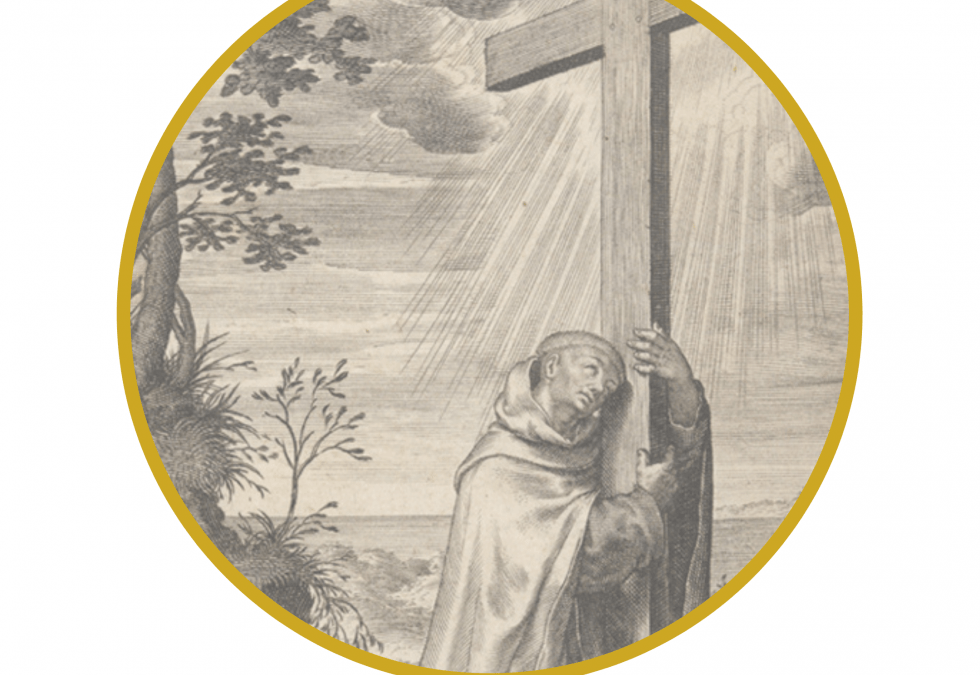
14 December: Saint John of the Cross. Born in 1542 as Juan de Yepes, he was the son of a poor silk weaver in Spain. His father was of noble birth but had married much beneath him and thus had been cut off by family. He had taken to silk weaving as a means of livelihood, but had never been able to make much of it. Soon after the birth of Juan, he died. The family was left in dire poverty; the children grew up always underfed, so much so that to the end of his life, Juan remained dwarfed in stature. Unable to learn a trade, he became the servant of the poor in the hospital of Medina, while also pursuing sacred studies. In 1563, Juan became a lay-brother to the Carmelite friars, who had him ordained priest. St. Teresa of Avila then strongly persuaded him to help her reform the Carmelite Order. Together they founded the Discalced (meaning “barefoot”) Carmelites, an order devoted to service of the Blessed Mother through prayer and penance. He took the name “John of the Cross.” His reform of the Carmelites, though approved by the general, was rejected by the elder friars, who condemned him as an apostate, and cast him into prison. He escaped after nine months of suffering (being beaten and nearly starved to death). Twice again, John was persecuted by his brethren and publicly disgraced. This only deepened his interior peace and devout longing for heaven. He had a great devotion to Our Lord’s Passion and voluntarily sought out humiliations. When Our Lord asked him what reward he would ask for his labors, John answered: “To suffer and to be despised for Thee.” On December 14, 1591, John was dying of a painful infection at only 49 years old. He asked to have “Song of Songs” read to him. While listening, he was heard to say, “So beautiful are the flowers!” And then he died. St. John was a great contemplative and spiritual writer. His mystical poems on divine love are considered some of the greatest verses ever written in the Spanish language. Among the Church’s contemplatives, St. John is known as a master of mystical theology and has had a great influence on Catholic spirituality. Saint John of the Cross was beatified by Pope Clement X in 1675; canonized by Pope Benedict XIII in 1726; and proclaimed Doctor of the Church by Pope Pius XI in 1926. He is the patron of contemplative life, mystical theology, mystics, and Spanish poets.
“With what procrastinations do you wait, since from this very moment you can love God in your heart?”
(Excerpt from Prayer of a Soul Taken with Love — St. John of the Cross)
Ideas for celebrating this feast day at home:
- A Spanish-inspired dinner would be perfect for St. John’s feast day. Try this easy recipe for Spanish rice with beef. Other ideas would be gazpacho soup, tapas, or a Spanish paella!
- In honor of the Carmelite order, make a caramelized treat for dessert: caramelized brown butter rice krispies or homemade caramel candies
- John was a prolific writer and poet. Today, ask children to write a small poem in honor of Christ or the Cross. These little poems of faith could be placed in the Christmas manger as a gift to Jesus.
- Three of St. John’s works, Ascent of Mount Carmel, Dark Night of the Soul,and Spiritual Canticle of the Soul and the Bridgegroom Christ are available online at the Christian Classics Ethereal Library.
- Reflect on the following sayings from St. John of the Cross: “In the evening of your life you will be judged by your love.” / “Where there is no love, put love and you will find love.” / “Keep your heart in peace; let nothing in this world disturb it; everything has an end.”
Recent Comments