
by popadmin | Dec 14, 2020 | CIC Saint Writeups
26 December: Feast of Saint Stephen. On the second day in the octave of Christmas, we celebrate the Feast of St. Stephen, an early Church deacon and the first Christian martyr. The Book of Acts 6-7 tells us about Stephen. He came from a family of Hellenists, Jews who had emigrated from Palestine to the Greek-speaking provinces of the Roman Empire. Tension arose between the Greek Jewish converts to Christianity and the Palestinian Jewish converts. The Greeks thought their needy were being neglected in favor of the Hebrew’s poor. To resolve the problem, the apostles ordained seven men as deacons to serve the poor and preach the Faith. The first name on this list of seven is Stephen. Stephen was renowned for his care of the poor and was held in high esteem by the Apostles. In his zeal for the Faith, he also debated with members of four Greek synagogues. When Stephen’s eloquent speeches got the better of the Hellenist Jews, angry opponents dragged him to the Sanhedrin. False witnesses charged him with blasphemy and reviling the Law of Moses. In answer, Stephen gave a lengthy speech that traced the sacred history of the Jews and concluded with a denunciation of his accusers. Then, suddenly filled with the Holy Spirit, he looked up to heaven and cried, “Behold, I see the heavens opened, and the Son of Man standing at the right hand of God.” This was too much blasphemy for the angry mob of Jews. (The man later to become St. Paul was part of the mob.) They rushed upon Stephen, dragged him outside the city walls and stoned him to death. As the stones struck, he prayed, “Lord Jesus, receive my spirit.” Then, when down on his knees and near death, Stephen prayed again, “Lord, lay not this sin to their charge.” After the mob had dispersed, Christians took his body away for burial.
The Church draws a comparison between St. Stephen and Christ: Stephen’s arrest and trial with false accusations parallels our Savior’s trial; he was stoned outside the city wall; he died echoing the words of Jesus on the cross (praying for his executioners). Saint Stephen is the patron of deacons, altar servers, bricklayers, stonemasons and horses.
Ideas for celebrating this feast day at home:
- A traditional St. Stephen’s meal is mincemeat pie. Here is an old time recipe. OR, try a new twist on mincemeat pie using leftover holiday turkey or ham: click here.
- Bake “St. Stephen’s Horns” called Podkovy: In honor of his patronage over horses, special sweet breads are baked in the form of horseshoes. These “horns” are much like coffeecake. Recipe here.
- St. Stephen was stoned to death while praying for his enemies. Today, pray for your enemies and for the persecuted Church throughout the world.
- Boxing Day: St. Stephen was one of the first ‘social workers’ in the Church; it was his task to feed the poor. In remembrance of his work, Britains used to collect money during the year in little clay boxes. On the feast of St. Stephen or ‘Boxing day’ as it is called in Britain, these boxes were broken and the money distributed to the poor. Perhaps you can revive this old tradition in your home!
- Another idea: In some homes a box is labeled and set beside the Christmas tree. Family members, in gratitude for their Christmas blessings, choose one of their gifts for the “St. Stephen’s Box” and then donate the gifts to the poor.
- Read the story of Good King Wenceslaus, also a Catholic martyr, who “looked out on the Feast of Stephen” and shared his meal with a poor family.
“If you know what witness means, you understand why God brings St. Stephen, St. John, and the Holy Innocents to the crib in the cave as soon as Christ is born liturgically. To be a witness is to be a martyr. Holy Mother Church wishes us to realize that we were born in baptism to become Christ — He who was the world’s outstanding Martyr.” — Love Does Such Things, by Rev. M. Raymond, O.C.S.O.
by popadmin | Dec 14, 2020 | Bulletin
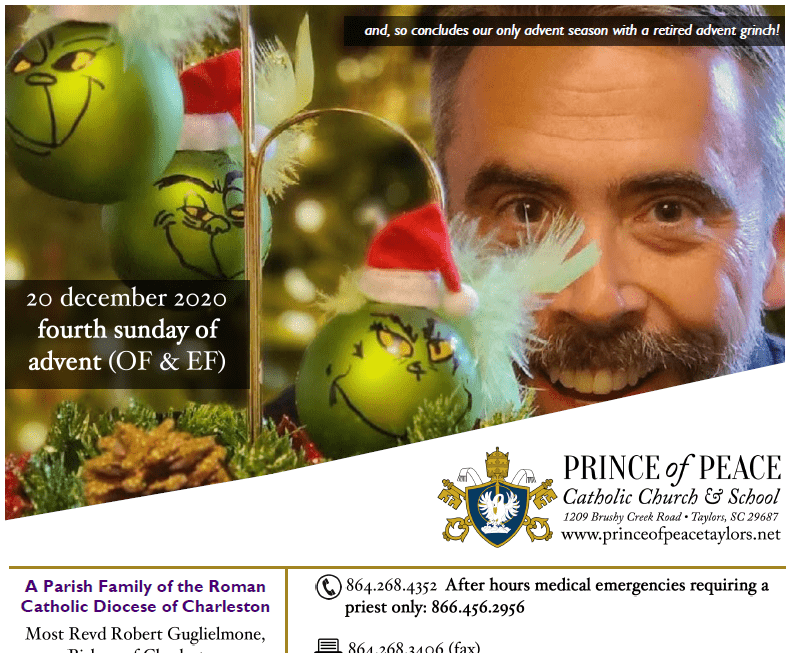
Click to read this week’s bulletin: 20 December 2020
by popadmin | Dec 14, 2020 | COVID-19
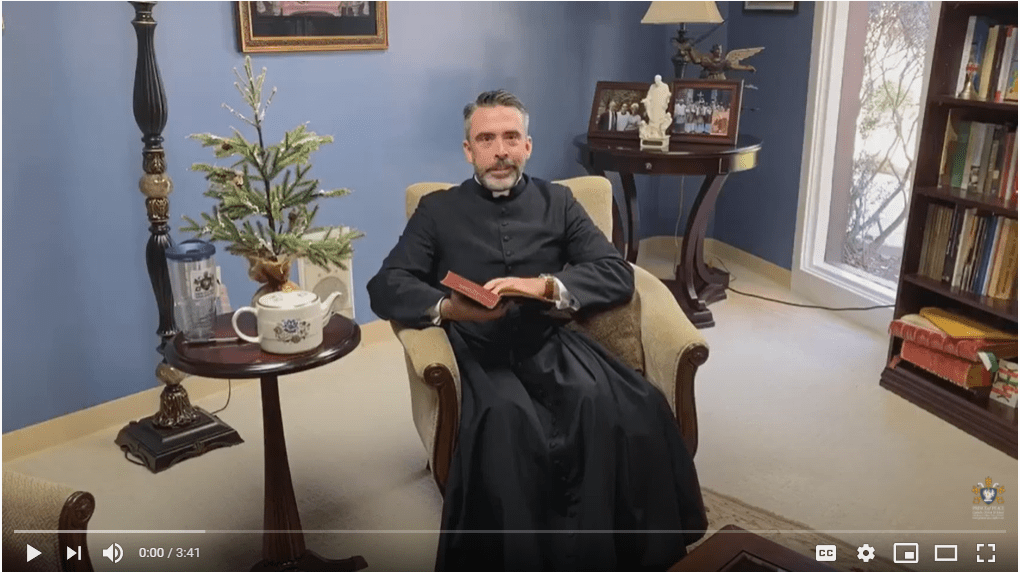
Fr Smith has an important video message announcing a new initiative at Prince of Peace. We have a number of parishioners who would love to come back to Mass and Holy Communion, but they or their families have very specific health needs.
Beginning the first Sunday of January, there will be a Low Mass in English in the PAC with no music or homily at 9.15a. This is an experiment meant to accommodate more of God’s children whose needs are not bring met by current practices in our parish. This Mass will be mask only. Depending on the numbers at that Mass and how that affects numbers at other Masses, it will continue or cease.
This will create an opportunity for a worship environment which more closely meets the specific health needs of a certain group of our parishioners during the pandemic.

by popadmin | Dec 10, 2020 | COVID-19
[pdf-embedder url=”https://www.princeofpeacetaylors.org/wp-content/uploads/2020/12/Basketball-Protocol.pdf” title=”Basketball Protocol”]
by popadmin | Dec 9, 2020 | COVID-19
Dear Friends in Christ,
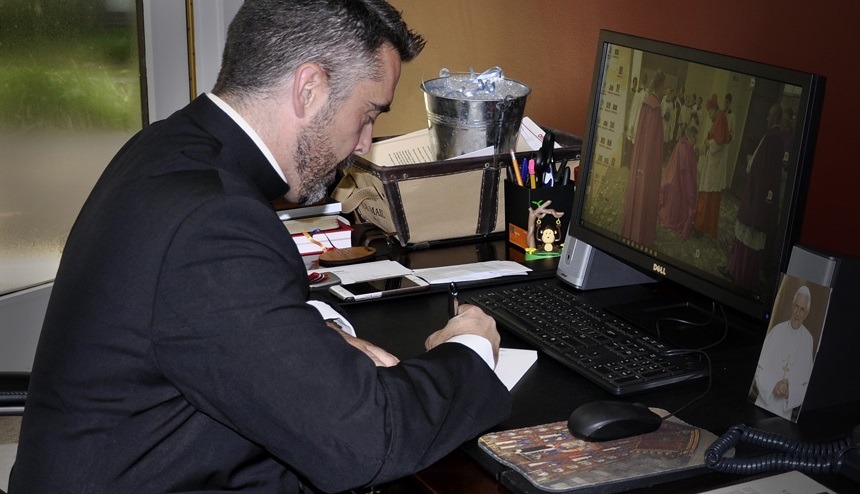
I recently wrote a pastoral letter encouraging people who are not in high risk groups to return to Mass, and for those who are returning to Mass to observe the recommendations of the CDC for social distancing, masking and sanitizing. When we reopened, I made it clear that we would reassess some of our protocols and policies as we dealt with what works and what does not work. The time for that reassessment has come and we have made a few decisions that I want you to be aware of.
All parish social events will be cancelled beginning 24 December until further notice. There are a few events on the calendar until then that will take place as planned. We are making tentative plans for a celebration on St Joseph’s Day in March, but there will not be anything at least until then.
In the PAC, those involved in parish athletic and ministry activities will receive notification from their leaders about new policies and protocols that go into effect immediately regarding the conditions under which those events and ministries can function. The School, RE, CYO and Choirs all have done an excellent job of putting together a protocol for temperature taking, masking when social distancing is impossible, and sanitizing. All other parish programs will be brought into alignment with those protocols. Because each program functions a little differently, you will receive specific notifications about each one. Failure to comply with the directives will mean that you will be asked to leave the property, and continued failure in this manner will mean the cessation of the specific ministry at this time.
In the church: Because our church is larger than many of the other Catholic churches in town, it provides greater possibility for social distancing. When we came back to church, we asked people to responsibly distance themselves. We have encouraged people to mask when inside the building, according to the CDC recommendations. As more people come back to Mass, and social distancing becomes more challenging, it is more imperative to mask. Of course, there are some people that have legitimate medical or practical reasons why masking is not possible, and it is important that we respect that. However, it must be observed that, if masks are required in all enclosed public spaces in the area, it is reasonable to ask our people to mask unless they are otherwise unable to do so.
As COVID cases and deaths rise in Greenville County, we reserve the right to amend these instructions at any time. In the meantime, let us pray for an end to this pandemic, for the protection of caregivers, for the sick and dying, and for the repose of the souls of all who have passed during this time.
Sincerely in Christ,
Father Christopher Smith, STD
Pastor
by popadmin | Dec 8, 2020 | Bulletin
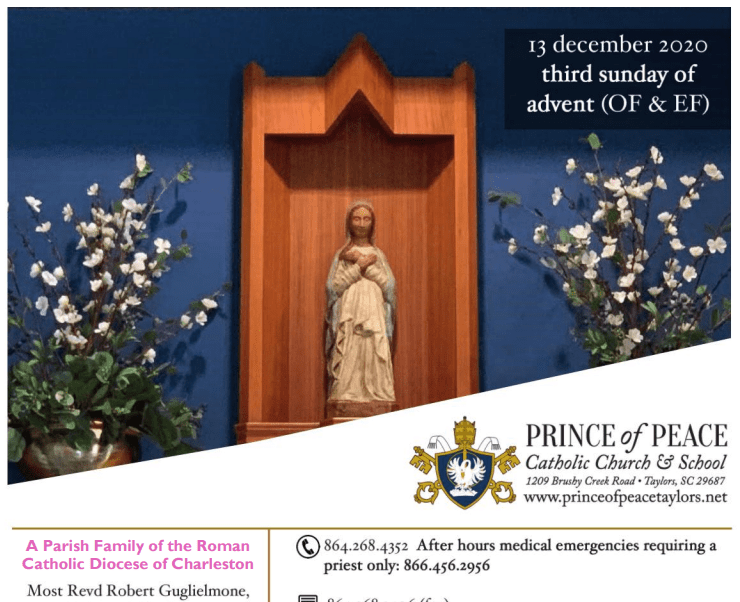
Click to read this week’s bulletin: 13 December 2020
Recent Comments